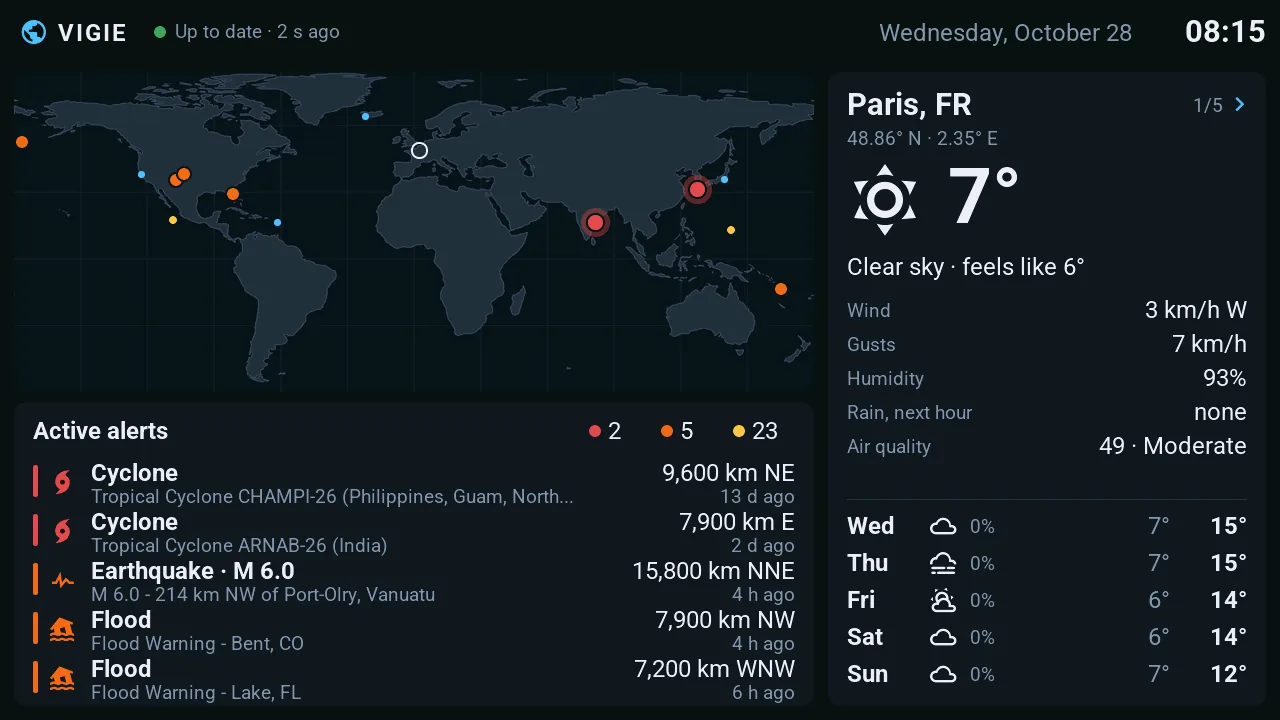
5 inch · 1280 × 720
M5Stack Tab5
The 7B layout scaled up by 20 %. Runs on an ST7121 since 2026-10-28; ST7123 and ILI9881C compiled, not yet run.
Vigie on the Tab5 and its configurationThe official weather warnings of 48 countries and natural disasters worldwide, on a map, on a "Near me" page and in Home Assistant.
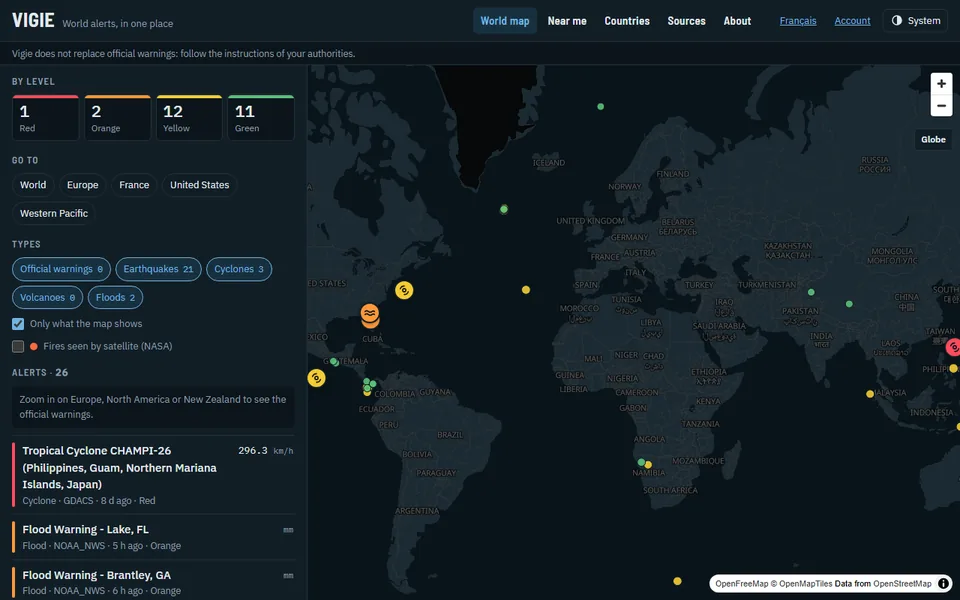
Vigie does not replace official warnings: always follow the instructions of your authorities.
All current alerts, with a list filtered by level and type, then a page per country, per area and per alert, where the issuer's text is kept unchanged.
A place chosen by name, the browser's location or a click on the map. The place stays in the browser; only a position rounded to about 5 km goes to the server, for the weather.
Cone and track of tropical storms, tsunami arrival times, and active fires seen by satellite (tick them on the map).
For accounts, by invitation, with a passkey, no password or email: one alert per area and level, and at night only red alerts.
No ads, no audience measurement, no third-party script or font; the only cookie remembers the language.
Natural disasters: earthquakes, tsunamis, volcanoes, cyclones, tornadoes, floods, extreme rain, wildfires and solar storms. Sources: USGS, EMSC, GDACS, USGS Volcano, NHC, NOAA SWPC, NASA FIRMS.
Official weather warnings, in green, yellow, orange and red (wind, rain, thunderstorms, snow and ice, heat, cold, floods, avalanches, coastal, fire, fog):
When a country is not covered, the reason is shown (for instance a license that forbids redistribution). The full list, with licenses, is on the sources page.
Maps, country pages, "Near me", accounts and notifications. SvelteKit and MapLibre, OpenFreeMap base map.
vigie-web on GitHubAll sources in one format: GeoJSON, CAP 1.2, JSON, and a compact frame for small screens. An unknown value stays empty, never made up. Python and FastAPI.
vigie-api on GitHubAn integration (through HACS, as a custom repository): highest warning level, active warning, start, upgrade and end events, strongest earthquake near the house. No key needed.
Install the integrationA standalone alert screen, without Home Assistant, for the Waveshare ESP32-P4 7B or the M5Stack Tab5: world map, the 5 most severe hazards with distance and direction, weather. ESPHome and LVGL.
The alert displayA touch screen standing in the house, showing the disasters under way around the world and the weather of the places that matter to you. It stands on its own: no Home Assistant, no app, just Wi-Fi. Its firmware, vigie-display, is made with ESPHome and LVGL, under the MIT licence, in English or French.
The link to the API (up to date, waiting, unreachable, with the age of the data), the date and time of the zone on screen.
Current hazards as dots coloured by severity (red, orange, yellow, green), and the zones you watch.
Earthquake, cyclone, volcano, flood, fire… with the magnitude when there is one, the source title, distance and direction from the zone on screen, and the age of the alert.
Current weather, wind and gusts, humidity, rain in the next hour, air quality, waves for coastal zones and a five-day forecast. Touch the panel to go to the next zone.
A value the API does not know is left off the screen, never invented. If the API stops answering, or an answer arrives incomplete, the screen keeps the last data and says so in the status bar.
The 7B layout scaled up by 20 %. Runs on an ST7121 since 2026-10-28; ST7123 and ILI9881C compiled, not yet run.
Vigie on the Tab5 and its configuration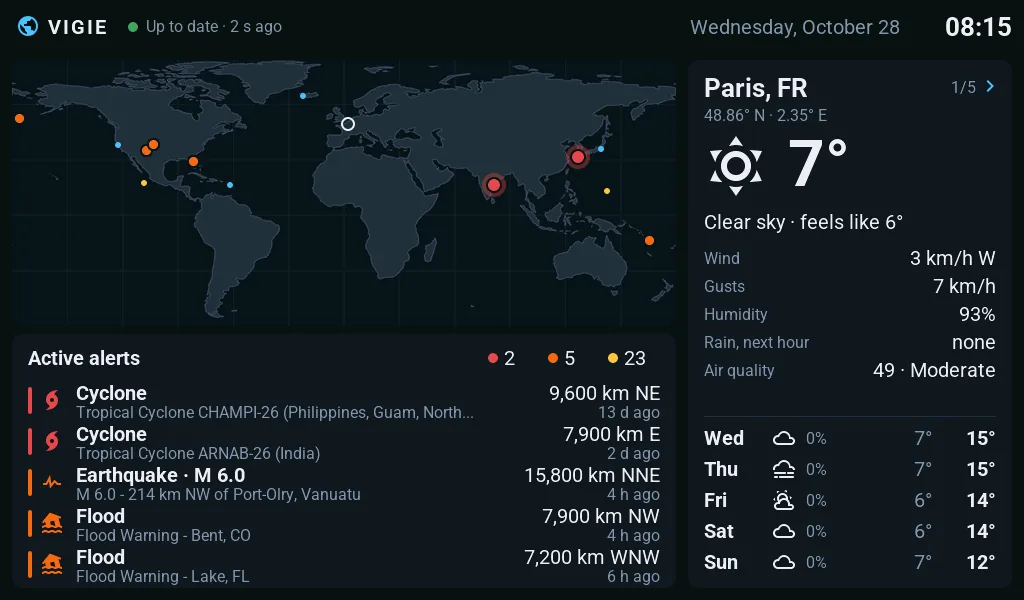
The reference layout, to the pixel. Tested on the board on 2026-10-20.
Vigie on the 7B and its configurationRendered from the firmware itself on a PC by continuous integration, with a live frame of the public API.
Every minute the screen asks the Vigie API for one compact frame; it never talks to the sources directly, nor to Home Assistant. With the public API (https://vigie.auxfilsdesidees.fr, free but rate-limited and with no guarantee of service), it shows the demo zones: Paris, Tokyo, Pointe-à-Pitre, San Francisco and Reykjavik in October 2026. With your own API, on a PC, a NAS or a Raspberry Pi on your network, it shows the zones you add to it.
The public instance is at https://vigie.auxfilsdesidees.fr/v1, read only. A few routes:
/v1/point?lat=…&lon=…: warnings, nearby hazards and weather for a place;/v1/vigilances and /v1/vigilances.geojson: current warnings;/v1/geojson/hazards: current disasters; /v1/cap/alerts: the same in CAP 1.2;/v1/earthquakes, /v1/fires, /v1/history;/v1/stream: a WebSocket to receive new alerts.Limits per address: 300 requests per minute, and 10 per minute (120 per hour) on /v1/point. You can also host your own instance: the code is MIT licensed; the data keeps its source's license.
Turkey has no reusable official feed. At the request of a user of the Home Assistant display, Vigie computes an unofficial pre-alert per province from the ECMWF model, available only in the API and as an option in the Home Assistant integration. Over the test year it caught 63% of episodes on the day and 71% the day before, and no wind episode: it in no way replaces the warnings of the Turkish weather service.